I am super sensitive to mold.
I often smell it in stores, buildings, and most concerning, hotel rooms.
Even the nicest hotels often have mold in their air ducts, especially those located near water sources. As I frequently travel with only carry-on luggage for work and prefer to stay in the hotel near the event, I have had to figure out a low-cost, portable solution to help mitigate mold on the go.
This past weekend at an event in Scottsdale, I shared my mold mitigation secret with mold-sensitive friends and colleagues who told me this solution “literally saved their life”.
Today, I am excited to share my favorite mold mitigation secret with you!
How Essential Oils Purify Air and Kill Mold
Essential oil vapors have been found to neutralize the respiratory impact of airborne mycotoxins from mold.
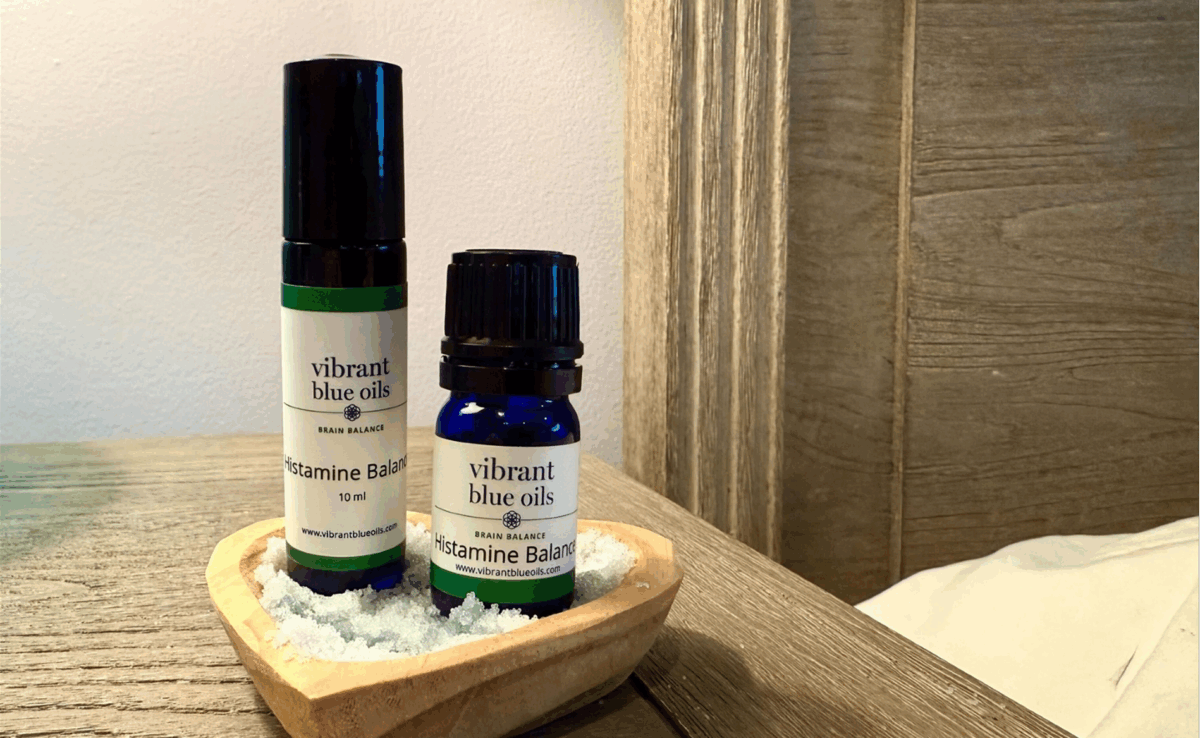
When I travel for business, I bring a small bottle of Histamine Balance oil, which I disperse into the air to help improve indoor air quality and combat mold spores.
It does not require expensive air purifiers or diffusers. Just a few drops of Histamine Balance oil in a small bowl of salt, which acts like a diffuser.
I keep the salt on the nightstand, and it literally helps neutralize and purify the air.
Research supports this, noting that essential oils possess antifungal properties that help purify the air and mitigate the effects of airborne mold spores. According to research on the Ability of Essential Oil Vapors to Reduce Numbers of Culturable Aerosolized Coronavirus, Bacteria and Fungi, essential oil vapors reduced the number of viable spores by 72% AND they start reducing mold spores as quickly as 10 minutes!
Essential oils release volatile compounds into the air that have been shown to reduce the presence of airborne mold and bacteria. A 2021 study on the antimicrobial activity of volatile substances from essential oils found that airborne vapors from antimicrobial essential oils, such as rosemary, tea tree, and thyme, demonstrated significant antimicrobial activity, which may help purify the air and inhibit or kill certain types of mold. Essential oils can also help prevent, reduce, and halt the further spread of mold growth.
Many essential oils can also act as natural air fresheners, helping to mask unpleasant odors without introducing the synthetic chemicals found in many commercial air fresheners. I often carry oils with me to counteract the smell of commercial air fresheners in Ubers and other enclosed environments, such as office spaces, airplanes, and hotels.
What’s more, essential oils with expectorant properties, such as Peppermint and Eucalyptus, may act as a natural decongestant, providing respiratory support and helping to maintain clear airways.
How Airborne Mold Spores Can Impact Your Health
Airborne mold spores are often inhaled through your nose and throat, impacting your sinuses, eyes, throat, lungs, and gut.
The toxic byproduct of mold, known as mycotoxins, are known neurotoxins that can damage your brain and your nervous system, contributing to symptoms like:
- Brain fog
- Fatigue and lethargy that don’t otherwise make sense
- Unexplained mood changes, anxiety, or depression
- Trouble sleeping
- Unsettled feeling, unquieted mind, overwhelm
- Frequent or intense static shocks
- Itchy or burning skin
- Histamine intolerance
- Sensitivity to EMFs
- Chronic sinusitis, nasal and sinus inflammation or congestion, runny nose
- Ear ringing, feeling itchy, plugged, clogged, or in pain
- Persistent coughing or difficulty breathing
- Eye irritation; red, itchy, and watery eyes
- Sneezing / Sneezing fits
- Skin irritation or rash
- Headaches
- Chemical sensitivities
- Acute sense of smell for mold
- Shortness of breath, air hunger, or yawn/sigh often
- Easy bruising
Essential Oils to Purify the Air and Kill Mold
Mold starts in the nose, where the inhalation of tiny fungi, known as mycotoxins, through the nasal passages contributes to sinus inflammation and congestion.
The inhalation and intranasal application of antifungal essential oils can help ensure that mold also ends in the nose by helping to reset your nasal microbiome.
Your olfactory system—the neural pathway for the sense of smell—directly communicates with your brain. This means that when you inhale toxins—like mold—they can travel directly into your brain through the olfactory neurons.
Similarly, natural remedies like essential oils—complex aromatic chemical products extracted from a diverse range of plants—also travel directly into the brain via the olfactory system, with antibacterial and antifungal constituents that help neutralize the impact of and offer relief from mold spores.
Essential oils serve as part of the plant’s immune system and contain therapeutic properties that protect plants from fungus, including mold, bacteria, and viruses. Essential oils are comprised of different chemical structures, including aldehydes, phenolics, and terpenes, some of which are believed to disrupt the fungal cell membranes of mold and destroy mold spores. Essential oils are believed to be effective against a diverse range of pathogens.
This is why blends of different essential oils are more effective for combating mold. Blends combine the antifungal, antibacterial, antiparasitic, antiviral, and antimicrobial properties of several individual oils, making them more effective than single oils used in isolation to combat mold.
The antimicrobial compounds in some essential oils are believed to disrupt the membranes and cell walls of mold spores, leading to the rupture and death of the mold cells. Research on Antifungal activity of essential oils against fungi isolated from air found “Essential oils have been demonstrated to have antifungal capabilities” that inhibit fungal growth. Clove oil was found to be most efficacious, performing better than traditional cleaning compounds such as vinegar.
How to use Essential Oils for Mold?
Essential oils can be used as intranasal treatments to clear nasal passages and relieve symptoms of sinus pressure and congestion. The best way to relieve sinus congestion and alleviate nasal mold exposure is through inhalation.
You can inhale oils in several ways:
- Inhaling directly from the bottle
- Applying Intranasally with a Q-Tip
- Diffusing into the room—I like to drop a few drops into a bowl of salt to naturally diffuse and disperse the essential oils into the air (which accesses the same olfactory neuronal pathway as mold) to clean the air and balance the body.
The following blends can help neutralize mold.
Histamine Balance™
One of the reasons mold is such a potent toxin is its ability to cross directly into the brain through the olfactory system. Anything you inhale, including essential oils, can travel directly into your brain via your olfactory neurons. I suspect this is one of the reasons that some of us are so sensitive to smells like perfume, cigarette smoke, and gas fumes.
Conversely, inhaling, topically applying, or diffusing Histamine Balance™ seems to help modulate the immune response to mold quickly.
As you may know, Histamine is a chemical compound released by cells in response to injury, allergic, or inflammatory reactions, causing the contraction of smooth muscle and dilation of capillaries. While the release of histamine is a standard defense mechanism, an exaggerated histamine response can bind to cell receptor sites, causing irritation and chronic inflammation. This inflammatory response can cause sneezing, runny nose, watery, red, itchy eyes, rashes, breathing troubles such as wheezing, severe coughs, asthma, or hiccups.
Histamine levels are designed to be kept in balance by two enzymes that break down excess histamine and prevent allergic reactions. One of these enzymes resides in the lining of our intestines and is necessary to maintain balanced histamine levels in the gut. A damaged gut lining compromises the production and secretion of this enzyme, allowing histamine to accumulate and cause harm throughout the body.
The goal is to balance, not block, the histamine response as histamine performs critical functions in the body, contributing to HCL production and neurotransmitter signals. The essential oils in the Histamine Balance™ blend are uniquely suited to help modulate excess histamine excretion, balancing histamine levels and helping to reset the immune response and reduce allergic reactions. Blue Tansy, in particular, is known for neutralizing histamine and helping to control allergic reactions.
Histamine Balance™ may help modulate the immune response to mold.
The research backs this up. In addition to Blue Tansy, which is known to modulate histamine responses, the blend contains Lavender, which is known for its antifungal properties. Lavender oil demonstrated inhibitory effects on mold growth and sporulation in several studies. The primary active components in lavender oil are linalool and linalyl acetate, which have demonstrated antibacterial and antiviral properties that may be beneficial for purifying the air.
The blend also contains Manuka oil, which is derived from the powerful antimicrobial and antifungal tea tree plant native to New Zealand. This oil is more potent and has stronger, broader-spectrum antimicrobial properties than conventional tea tree oil due to its higher concentration of triketones. Research on the effects of evaporating essential oils on indoor air quality found that evaporating tea tree oil in a room can temporarily decrease the concentration of airborne mold. The primary active compounds in tea tree oil are alpha-terpineol and terpinen-4-ol, which kill mold spores by disrupting the cell wall and causing cells to rupture and leak. Rosemary oil is also known for its antifungal properties, making it an excellent choice for halting mold growth. Similarly, Peppermint and Ravensara are beneficial in preventing the effects of some mycotoxins.
For intranasal application, coat two cotton swabs in Histamine Balance™ blend, and either swab or gently insert the cotton swabs into your nose. You can also apply 1-2 drops topically to the bottom of the feet. For allergic reactions, smell or apply 1-2 drops behind your ears, on the back of your neck, or on your sternum to open airways. For the gut and food intolerance support, apply in a clockwise direction around the belly button. For brain congestion, apply 1-2 drops at the base of the skull on the back of the head. For Aromatic Usage, hold the bottle under your nose for 3 or 4 breaths.
To learn more about balancing the Histamine Reaction to mold, CLICK HERE.
Parasympathetic®
Mold exposure can induce a state of chronic stress that overstimulates the sympathetic “fight-or-flight” nervous system, resulting in a suppressed parasympathetic “rest-and-digest” response. Parasympathetic® can help activate and strengthen the parasympathetic system, supporting the body’s ability to heal and recover.
This blend contains clove and lime, which significant research supports using to help eradicate or prevent surface-level mold. Clove oil is known for its antibacterial, antiseptic, antifungal, insecticidal, and antioxidant properties and has been found to inhibit the growth of molds, yeasts, and bacteria. In fact, clove oil was observed to be the essential oil with the greatest broad-spectrum inhibitory effect to suppress mold growth. Evidence suggests that clove oil can kill mold and fungal spores almost as effectively as commercial disinfectants.
These antimicrobial properties may be attributed to high levels of eugenol, a principal constituent of clove oil. Eugenol possesses a chemical structure known as a hydroxyphenyl propene, which enables it to alter and damage the permeability of a fungus’s cell membrane, causing its cell contents to leak out and ultimately destroying the fungus itself. This is the reason that eugenol is associated with antioxidant, antimicrobial, and anti-inflammatory activities. It protects your cells against fungi and bacteria.
One study found clove oil to be powerful against Aspergillus, the most dangerous form of black mold.
Citrus oils, such as lime, are also known to be antifungal, as they are able to break down mold spores at a molecular level. Parasympathetic blends a combination of clove and lime and may help eradicate surface mold and prevent mold from forming on surfaces like shower grout and bathtub caulking.
To stimulate the parasympathetic response, apply Vibrant Blue Parasympathetic™ blend to the vagal nerve (behind the earlobe on the mastoid bone) throughout the day and before meals.
You can also support detoxification through the skin by adding 2-3 drops of Parasympathetic™ oil to a Healing Bath (2 cups of Epsom salt, 1 cup of baking soda). For more tips on healing baths, read this article and download this FREE guide.
Sinus Support™
Mold is often a root cause of chronic sinus issues. When mold enters the sinus cavity, a suppressed immune system is likely to have a strong adverse reaction, resulting in fungal sinusitis. Since fungi thrive in damp, dark conditions, the sinus cavity provides an ideal environment for growth, making it challenging to eliminate them once they are established.
Your sinuses are a connected system of hollow cavities in the skull that drain into your nose. Typically, the sinuses are empty except for a thin layer of mucus. When your sinuses are inflamed due to mold exposure, thick mucus fills the nasal cavity, causing your tissue to swell and blocking the drainage openings into your nose, so fluid can no longer escape. This then leads to the common symptoms of sinusitis: headaches, facial pressure, and even toothaches resulting from nerve impingement in the surrounding area.
Essential oils can easily penetrate the small holes to loosen mucus and promote drainage. Sinus Support™ works as a local decongestant that breaks up mucus, stimulates drainage of the nose and sinuses, and relieves head pressure. Essential oils are also antimicrobial, helping to resolve infections caused by organisms such as bacteria, viruses, and fungi in the sinuses and nasal cavity.
Sinus Support™ is designed to help clear and open the nasal passages and relieve sinus pressure from chronic sinus infections and/or sinus issues related to allergies. Formulated with essential oils with known antifungal, anti-inflammatory, antibacterial, and antiseptic properties that penetrate the nasal lining for rapid relief when inhaled—like Peppermint™, which is high in the constituent Menthol which is known to relieve sinus congestion and pressure and Eucalyptus which is high in antibacterial, antispasmodic, and antiviral properties (including 1,8 cineole) which help open airways and relieve congestion naturally.
Sinus Support™ can be inhaled or applied topically. Apply 2-3 drops to a cotton swab and swab the inside of the nasal passages 2-6 times daily. For optimal effectiveness, you can leave the cotton swab in the nasal passage for up to 20 minutes. Try to relax and focus on breathing through the nose.
Featured Oils:
Ready to get started? Click the links below to order today:
References: